|
 |


Overview |
Picking a Topic |
Tech Decisions | Design Decisions
Usability Testing |
What Went Right |
What Went Wrong | Conclusions
Summary: What Went Wrong
Architecture Complexities
Ironically, flashy real-time 3D games require that you keep visual details
to a minimum. Curved surfaces, complicated architectural details and massive
textures will slow down the game’s framerate and potentially ruin the level.
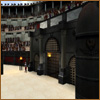
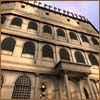
Picking a structure that essentially consists of nothing but curved surfaces
(the Roman Colosseum) may have been a bad move, especially for a beginner. I
don’t regret tackling the structure, but I imagine the result would have
been better (and the time spent decreased) had I cut my teeth on a building
that was a bit more traditional.
Tedious Model Creation
Although modeling a low-polygon character is an arduous task in its own
right, the model conventions for the Jedi Knight II engine are particularly
annoying. Since the game engine allows a player to dismember enemies with
swords, this requires models to be constructed and named in a very specific
way. Among other things, this involves the added task of lining up textures
along these multiple seams, capping the separate limbs and naming them
appropriately, setting up a complicated hierarchy structure and praying that
it doesn’t all fall apart when exported to the required XSI format. Add to
that the fact that models are restricted to a specific skeleton that ships
with JKII, and you’ve got yourself a modeling job that would test anyone’s
patience.
Underestimated Texture Work
Due to my lack of experience, I simply did not realize the sheer amount of
time I would spend in Photoshop creating the custom illustrations that would
be pasted all over my architecture. Even though I understood that every
single surface in the game would require its own map, I assumed I would only
spend an hour or so on each detail. The problem I discovered is that
textures are sometimes the “first impression” that either draws a player in
or leaves them cold. Even if your architecture and lighting is exquisite,
there is no way to cover up a crummy, unconvincing texture. The result was
that I spent hundreds of hours creating and tweaking in Photoshop and Max.
The one consolation is that I am more or less happy with the final result.
Not Enough Time on Gameplay
The majority of time on this project was spent on learning new tools, and
then using those tools to create art assets. In order to make the game even
slightly interesting, I needed to have at least one compelling location (the
Colosseum) a bunch of assets to make it real (textures, sounds, etc) and at
least three or four custom characters to populate the world (the models).
Once all of this was complete, I found there were only a few months to
really make the level and tie all these assets together through scripting
and mapping. I am happy with the result and I will undoubtedly add new
levels and features for my own entertainment, but I am looking forward to
the next project where I will try to achieve more of a balance between art
asset creation and level design/scripting.
Inflexible Engine
If you talk to many mappers/modders, they will tell you that the Jedi
Outcast engine is largely useless because it only provides the ability to
swap assets and make maps. Other engines such as the original Quake III
allow access to the game source code which allows greater flexibility in
development. In my case, this meant that if I wanted the gladiator to fight
with and use a shield, I was out of luck. If I wanted a soldier to have a
sword in each hand and swing them in a particular way, I was out of luck. If
I wanted to completely alter the way a character interacts with the game
world – you get the idea. Given my time constraints, this lack of
flexibility did not affect me as much as it could have. In addition I felt
that being able to leverage all of the existing swordplay and animations was
worth the trade-off.
No Academic Support
When forming my thesis committee, I sought the advice of a couple of RIT
faculty members that had experience in the game industry. Unfortunately,
neither were interested in participating in my project, so the project
quickly became a very non-collaborative effort. My thesis committee members
were extremely helpful in providing feedback and critique and used every
opportunity to contribute and provide resources for the tasks at hand. My
chief advisor was also able to arrange a meeting with a professional 3D
modeler/animator which was invaluable.
However, specific problems or technical
difficulties were essentially obstacles I needed to resolve on my own. In
the section “What Went Right”, I mentioned the extremely helpful nature of
other mappers and modders on the World Wide Web, and I will mention again
that I would not have been able to complete this project without their help.
Messy Scripting
I mentioned that the scripting implementation, ICARUS, was very easy to
learn. What I did not mention is that the number of scripts I had to write
ballooned in size as I got further into the development of the game. As a
result, some of the scripts got a bit messy and it was sometimes difficult
to track down a particular piece of functionality if it had to be changed or
tweaked. The nature of level building with ICARUS makes it difficult to keep
things clean and tidy anyway, but I could have done a number of things to
make my life a bit easier. Some of these things could have included strict
naming conventions for the script and variable names and grouping together
of scripts by functionality.
Tired Subject Matter
I mentioned that the setting of ancient Rome made for exciting gameplay
and a rich level of historical detail. Focusing on gladiators and the games
did have certain drawbacks as well. The biggest problem with the setting is
that it has truly been done to death in the entertainment industry. Before
“Gladiator” ever hit the screen, there was “Spartacus”, “Ben Hur” and many
others. The video game industry has been returning to the Roman history well
countless times for Real Time Strategy (RTS) games, and Lucasarts is
launching a gladiator-themed Role Playing Game (RPG) within a few short
months. Through the course of my research, I even found other amateur
mappers and modders who were busy fashioning their own creations related to
ancient Rome and the gladiatorial games.
Apart from the blunt educational
aspects of the game, “Colosseum” is by no means an original game concept.
The attempted historical accuracy obviously precludes any truly original or
creative idea, but most players will also notice countless references and
tributes to movies and books alike. The upshot of all this was that, since
it was such a rich source of subject matter, I never became bored and I
never ran out of new ideas. The game, as it stands as of this writing, only
includes about 30% of the features I wanted to implement. As a result it has
become its own little hobby I can return to and tweak and edit without ever
really reaching a logical end to the story or adventure.
<< previous section (What Went Right) |
main | next section (Conclusions) >>
|